
The digital marketing landscape has fundamentally transformed how businesses connect with their audiences. Yet amidst countless agencies claiming expertise, one critical question persists: How do you identify the best digital marketing company for your specific needs? This is no longer a matter of simply choosing the cheapest option or the largest firm. Instead, selecting the right digital marketing partner requires a deep understanding of what genuinely separates exceptional agencies from mediocre ones.
The reality is that most businesses struggle with this decision. They’re bombarded with marketing jargon, conflicting claims, and agencies that overpromise results while underdelivering accountability. The stakes are high—your marketing budget directly impacts business growth, brand reputation, and revenue generation. A partnership with the wrong agency can waste months and substantial financial resources.
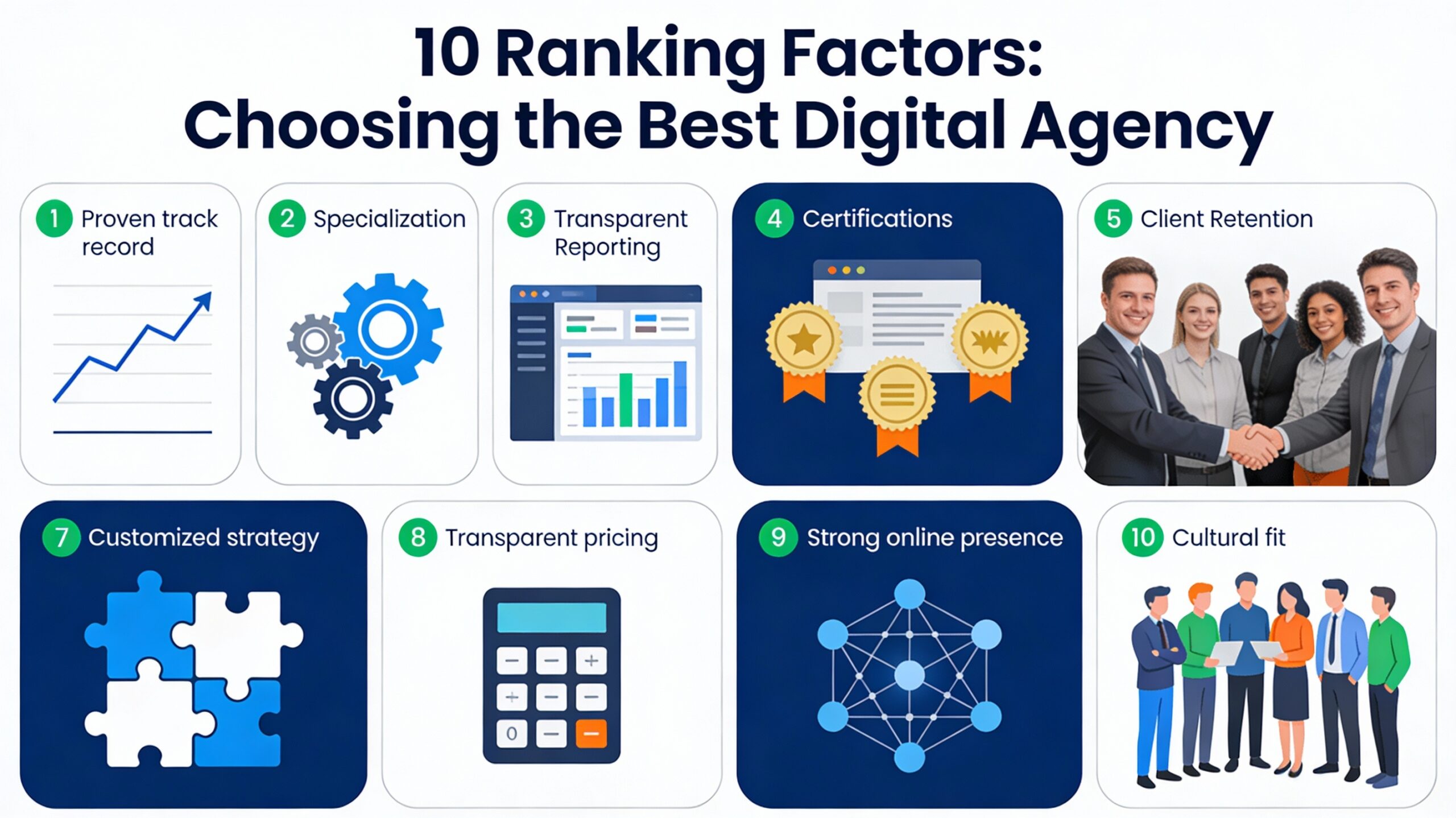
This comprehensive guide breaks down the 10 critical ranking factors that distinguish truly outstanding digital marketing companies from the rest. These aren’t arbitrary metrics; they’re evidence-based criteria that reflect how leading agencies operate in 2025.
1. Proven Track Record and Case Studies
The foundation of any credible digital marketing company rests on demonstrable results. A strong track record isn’t simply a collection of client names—it’s a documented history of measurable outcomes across diverse industries and business models.
When evaluating an agency’s track record, look for detailed case studies that showcase specific challenges, implemented strategies, and quantifiable results. The best agencies provide comprehensive breakdowns including initial metrics, the exact tactics deployed, timeline for results, and final outcomes. For example, a credible case study might detail how they increased organic traffic from 5,000 monthly visitors to 45,000 within six months for a B2B SaaS company, while simultaneously reducing cost-per-acquisition by 32%.
Red flags to watch: Agencies that provide vague testimonials without metrics, showcase generic results applicable to any industry, or refuse to share specifics “due to client confidentiality” without offering anonymized data. Legitimate agencies confidently display concrete results because their work speaks for itself.
The most reputable digital marketing companies maintain detailed case studies across multiple service categories—SEO success stories, paid advertising campaigns, content marketing transformations, and social media growth narratives. This diversity demonstrates adaptability and comprehensive expertise rather than reliance on a single marketing channel.
2. Industry Specialization and Niche Expertise
One-size-fits-all digital marketing strategies fail. The most successful digital marketing companies develop deep expertise within specific industries rather than attempting to serve every vertical equally.
Consider the difference between an agency that has managed campaigns for five different industries versus one that has become the go-to expert for legal services, e-commerce, or SaaS companies. The specialized agency understands industry-specific nuances, regulatory requirements, buyer behavior patterns, and competitive landscapes that generalist agencies discover only through expensive trial-and-error.
For instance, a digital marketing company specializing in family law practices understands the sensitivity of client queries, the specific keywords potential clients search, the geographic limitations of legal services, and compliance requirements. This knowledge translates into more effective strategies from day one rather than an extended learning curve at your expense.
When evaluating specialization:
- Ask about their experience with companies similar to yours
- Request case studies specifically from your industry
- Inquire about industry certifications or associations they maintain
- Understand their knowledge of your target audience’s buying journey
- Assess their awareness of industry-specific regulations and compliance issues
Agencies with genuine specialization invest in continuous learning, maintain relationships with industry thought leaders, and create proprietary frameworks tailored to their niches. This focus results in faster implementations, more relevant strategies, and superior outcomes compared to generalist approaches.
3. Transparent Reporting and Analytics Access
Transparency is the cornerstone of trust in any agency partnership. The best digital marketing companies provide real-time analytics access and comprehensive reporting that enables you to understand campaign performance independently.
This means direct access to Google Analytics, Google Search Console, paid advertising dashboards, and social media analytics platforms—not manually compiled PDFs that could contain manipulated data. Real transparency allows you to verify claims, identify trends, and make informed decisions about campaign adjustments.
Outstanding agencies provide:
- Live dashboard access with customizable metrics aligned to your specific KPIs
- Weekly or monthly reports that explain not just what happened, but why it happened
- Clear attribution models showing how different channels contribute to conversions
- Honest conversation about challenges alongside victories
- Actionable recommendations based on data analysis, not guesswork
The absence of direct account access is a significant warning signal. If an agency insists on being the sole interpreter of your campaign data, they’ve created unnecessary dependency and eliminated your ability to hold them accountable.
4. Certifications and Platform Partnerships
Professional certifications represent ongoing commitment to expertise and adherence to platform best practices. The digital marketing landscape evolves rapidly—Google updates algorithms, Meta introduces new ad formats, and new tools emerge constantly. Agencies that maintain current certifications demonstrate dedication to staying ahead of industry changes.
Key certifications to verify:
- Google Partner Status: Indicates Google Ads expertise, access to beta features, and direct Google support
- Google Analytics Certification: Demonstrates proficiency in data interpretation and measurement
- Google Career Certificates: Validates foundational and advanced digital marketing knowledge
- Facebook Blueprint Certification: Shows mastery of Meta’s advertising ecosystem
- HubSpot Certification: Reflects expertise in inbound marketing methodologies
- Microsoft Advertising Certification: Indicates capability in Bing ads and LinkedIn advertising
- Industry-Specific Certifications: Relevant to your business vertical
However, certifications alone don’t guarantee excellence—they’re a baseline requirement. Combine certification verification with other evaluation criteria. Ask to see actual certification badges and verify them through official channels like the Google Partners directory, Meta’s certification site, or HubSpot Academy.
5. Client Retention and Long-Term Results
Client retention rates reveal fundamental truths about agency performance. When agencies consistently maintain client relationships over years or maintain long-term contracts with industry leaders, it indicates they deliver genuine value rather than short-term optimization tricks.
Agencies with high client retention rates (above 90%) typically excel because:
- They build strategies for sustainable growth rather than quick wins
- They develop genuine partnerships understanding long-term business objectives
- They maintain accountability through consistent performance measurement
- They evolve strategies as market conditions change
- They prioritize client relationships over aggressive new client acquisition
Ask potential agencies about their average client tenure and reasons why clients leave. Agencies that candidly discuss client departures—perhaps due to businesses folding, budget cuts, or natural transitions—demonstrate honesty. Agencies that claim perfect retention should raise suspicion.
The most valuable partnerships often extend across multiple marketing channels over extended periods, allowing agencies to develop deeper expertise with your business, understand your audience more intimately, and compound marketing efforts over time.
6. Team Expertise and Size
The quality of your account team directly impacts campaign success. The best digital marketing companies employ specialists rather than generalists—dedicated SEO experts, paid media strategists, content creators, analytics specialists, and strategists rather than jack-of-all-trades account managers.
When evaluating team structure:
- Ask who will manage your account and verify their specific expertise through LinkedIn profiles
- Understand the support structure behind your primary contact—who handles execution if they’re unavailable?
- Assess team size relative to client load to ensure you receive attention rather than becoming another number
- Evaluate team continuity—frequent turnover suggests internal instability
- Review team certifications beyond the agency level
The ideal structure pairs senior strategists for strategy and guidance with experienced execution specialists for daily campaign management. This combination ensures both strategic vision and tactical excellence.
Beware of agencies where your primary contact handles multiple unrelated specializations, suggesting they lack depth in any particular area. Conversely, excessively large teams can indicate inefficiency and lack of accountability.
7. Customized Strategy Over Templates
Every business is unique, yet many agencies operate from standardized playbooks applied across dozens of clients. The distinction between good and great digital marketing companies often comes down to strategy customization.
The best agencies invest time in understanding your business before proposing solutions. They conduct competitive analysis, audience research, and capability assessments to develop tailored strategies rather than executing pre-designed templates.
Warning signs of template-based approaches:
- Identical recommendations across different client types
- Generic proposals lacking your company-specific insights
- Immediate solution recommendations without question-asking phase
- One-size-fits-all pricing packages
- Reluctance to adapt their methodology to your circumstances
The strategic discovery process for quality agencies typically includes:
- Comprehensive competitive analysis identifying your differentiation
- Audience research revealing decision-making processes and pain points
- Technical audits exposing current capability gaps
- Industry-specific opportunity identification
- Customized roadmaps with realistic timelines and milestones
This investment in customization separates agencies that deliver incremental improvements from those that drive transformational growth aligned with your specific business model and objectives.
8. Pricing Transparency and Value Alignment
Transparent pricing structures reflect agency confidence and commitment to fair partnerships. The best digital marketing companies clearly articulate what’s included, why it costs what it does, and how pricing aligns with expected outcomes.
Common pricing models in India (2025):
- Monthly Retainers: ₹25,000–₹1,00,000+ for ongoing services including SEO, content, social media, and PPC
- Project-Based Pricing: ₹50,000–₹5,00,000+ for specific deliverables like website redesigns or campaign launches
- Hourly Rates: ₹1,000–₹12,000/hour for consulting, audits, or strategic work
- Performance-Based Models: 10–25% of ad spend or percentage of achieved conversions
- Hybrid Models: Combination of retainer plus performance incentives
The best pricing approach aligns agency compensation with your success. Agencies with performance-based components demonstrate confidence in their ability to deliver results. Conversely, flat-fee agencies that guarantee specific outcomes signal accountability.
Red flags in pricing:
- Suspiciously low rates relative to competitors
- Hidden fees discovered during onboarding
- Unclear breakdown of what’s included
- One-price-fits-all structures regardless of company size
- Unwillingness to discuss pricing transparency
Quality agencies articulate exactly what services are included, how many hours/resources are allocated, what tools are provided, and whether costs scale with campaign complexity. This clarity enables you to evaluate whether pricing represents genuine value or simply appears cheap while delivering minimal service.
9. Strong Online Presence and Content Marketing
An underrated evaluation criterion: How well does the digital marketing company practice what it preaches? If they’re truly excellent, their own digital presence should reflect their expertise.
Evaluate their online visibility across multiple dimensions:
- Search engine rankings: Do they rank well for digital marketing keywords relevant to their expertise?
- Blog presence: Do they maintain a regularly updated, high-quality blog addressing industry challenges and opportunities?
- Social media engagement: Are they active, responsive, and sharing valuable insights on professional platforms?
- Website quality: Is their website fast-loading, mobile-optimized, and professionally designed?
- Thought leadership: Do they contribute to industry publications, speak at conferences, or publish original research?
The rationale is straightforward: if they cannot effectively market themselves using their own expertise, why trust them with your marketing? A digital marketing company with weak SEO, minimal content presence, or poor social media engagement likely lacks the execution discipline and strategic acumen they claim.
The best agencies use their own operations as testing grounds for new strategies, allowing them to share authentic insights about what works and why. Their content marketing demonstrates the quality you can expect in campaigns they create for you.
10. Cultural Fit, Communication, and References
Beyond metrics and credentials, successful agency partnerships require cultural alignment and genuine communication. The best digital marketing companies invest time understanding your organizational culture, decision-making processes, and communication preferences.
Evaluate cultural fit through:
- Responsiveness: How quickly do they respond to inquiries? What communication channels do they offer?
- Transparency: Will they candidly discuss challenges, failures, and lessons learned?
- Collaboration style: Do they view you as a partner or simply as a client generating revenue?
- Values alignment: Do their business principles align with your organizational values?
- Team personality: Can you envision working comfortably with these people over extended periods?
Request references from existing clients and actually contact them. Ask about responsiveness, handling of challenges, willingness to adapt strategies, and overall satisfaction. The agencies with the strongest references typically maintain them because of exceptional communication and partnership approach, not just results.
Communication cadence matters significantly. The best agencies maintain regular check-ins, provide easy access to team members, explain technical concepts in accessible language, and welcome questions rather than viewing them as interruptions.
Why GrowwUp Digital Excels in All 10 Factors
GrowwUp Digital has built its reputation on recognizing that digital marketing success requires more than tactical execution—it demands partnership, expertise, and unwavering commitment to client outcomes.
Proven Track Record: GrowwUp Digital maintains an extensive portfolio of case studies spanning legal services, e-commerce, SaaS, and service-based businesses, with documented results showing average organic traffic increases of 150–300% within six months and consistent lead generation improvements across client segments.
Industry Specialization: With particular expertise in legal services digital marketing, e-commerce SEO, and gaming platform optimization, GrowwUp Digital understands the unique challenges, regulatory landscapes, and audience behaviors within these niches, delivering strategies that account for industry-specific requirements from day one.
Transparent Reporting: Every GrowwUp Digital client receives direct access to live analytics dashboards, Google Search Console, and paid advertising accounts. Weekly optimization reports explain performance changes, identify opportunities, and recommend data-informed adjustments—no data manipulation or information gatekeeping.
Certifications and Partnerships: The GrowwUp Digital team maintains current Google Partner certification, Google Ads and Analytics certifications, Facebook Blueprint credentials, and SEO specialization certifications, reflecting ongoing commitment to leveraging platform updates and best practices.
Client Retention: With client retention rates exceeding industry averages, GrowwUp Digital’s long-term partnerships demonstrate consistent value delivery. Clients return because results compound over time and strategies evolve alongside business growth.
Team Expertise: GrowwUp Digital employs specialized professionals—SEO strategists, content creators, paid media experts, and analytics specialists—ensuring your account receives dedicated expertise rather than generalist management.
Customized Strategy: Every engagement begins with comprehensive discovery involving competitive analysis, keyword research, audience segmentation, and capability assessment. Strategies are tailored to your specific business model, target market, and growth objectives.
Pricing Transparency: GrowwUp Digital clearly articulates pricing structures, service inclusions, tool allocations, and expected outcomes. Hybrid pricing models align agency success with client success through performance-based components.
Strong Online Presence: GrowwUp Digital maintains active social media presence, regularly published content addressing digital marketing challenges, and consistent SEO performance for relevant keywords—proof of their own digital marketing excellence.
Cultural Fit: Working with GrowwUp Digital means partnering with professionals who view your success as their success, maintain responsive communication, welcome strategic discussions, and remain committed to long-term growth rather than short-term quick wins.
FAQ: Choosing the Best Digital Marketing Company
1. What defines the best digital marketing company?
The best digital marketing company combines proven track record with industry expertise, transparent reporting, credible certifications, long-term client relationships, specialized team expertise, customized strategic approaches, transparent pricing, strong personal digital presence, and strong communication practices. Excellence encompasses both technical capability and partnership approach—they must deliver results while maintaining genuine collaboration and accountability.
Beyond metrics, the best agencies align with your organizational culture, maintain proactive communication, welcome your involvement in strategic decisions, and demonstrate commitment to your long-term success rather than quick client acquisition. They understand your industry-specific challenges, maintain expertise in relevant platforms and methodologies, and prove their capabilities through their own marketing excellence.
2. How much does the best digital marketing cost in India?
Digital marketing costs in India vary significantly based on service scope, strategy complexity, and agency expertise. Standard pricing ranges for 2025 are:
- SEO Services: ₹12,000–₹50,000/month for basic to advanced keyword targeting
- PPC/Google Ads: ₹10,000–₹1,00,000/month (excluding ad spend; typically 10–20% management fees)
- Social Media Marketing: ₹8,000–₹40,000/month for content creation, scheduling, and community management
- Content Marketing: ₹2,000–₹10,000 per piece (blog posts, videos, whitepapers)
- Email Marketing: ₹5,000–₹25,000/month for automation, segmentation, and campaigns
Comprehensive packages combining multiple services typically range from ₹50,000–₹2,00,000/month depending on scope and business complexity. Most SMBs budget ₹50,000–₹1,00,000 monthly for integrated digital marketing support.
Performance-based pricing typically involves 10–25% of ad spend for campaigns where measurement and ROI are straightforward. Hybrid models combining retainer plus performance components provide flexibility and align agency incentives with client success.
The best approach is not selecting the cheapest option, but evaluating value relative to expected outcomes. Quality agencies demonstrate how investment aligns with revenue generation, lead generation, or traffic growth targets—making pricing decisions ROI-based rather than cost-based.
3. How to verify a digital marketing agency’s claims?
Verification requires systematic evaluation across multiple dimensions:
Direct Verification Steps:
- Request detailed case studies with specific metrics (traffic/lead/conversion numbers) before and after, timeline for results, and industry context
- Ask for client references and actually contact them to ask about reliability, communication, and results
- Verify certifications independently through official directories—Google Partners listings, Meta certification database, HubSpot Academy records
- Check business registration through GST registration lookup or company incorporation databases
- Review online presence across platforms—do their website, blog, and social media reflect the expertise they claim?
- Assess SEO performance using tools like Google Search Console data review, keyword ranking checks for relevant terms
- Evaluate content quality by reading their blog posts, case studies, and published materials
Warning Signs of Exaggerated Claims:
- Promises of guaranteed first-page rankings or “rank #1 for any keyword”
- Reluctance to provide direct account access or analytics
- Inability to explain their methodology in understandable terms
- Unwillingness to provide client references
- Generic proposals lacking industry-specific insights
- Inability to demonstrate their own digital marketing success
Request Verification Documents:
- Signed case studies with measurable metrics
- Verification links to certification profiles
- Business registration documents and GST certificates
- Client testimonial contact information
- Platform partnership verification screenshots
The best verification combines independent research (searching for their online presence, reading reviews on platforms like Google and Clutch) with direct inquiry (requesting documentation, speaking with references, asking detailed methodology questions).
Conclusion
Selecting the best digital marketing company requires moving beyond surface-level evaluations to understand what genuinely separates exceptional agencies from mediocre ones. The 10 ranking factors outlined in this guide provide a comprehensive framework for making informed decisions that align with your business objectives.
The investment you make in choosing the right digital marketing partner extends far beyond the monthly retainer—it impacts your brand visibility, customer acquisition costs, revenue growth, and long-term competitive positioning. Excellence in digital marketing compounds over time, making the quality of your agency partnership increasingly valuable.
GrowwUp Digital exemplifies these 10 factors through proven results, industry specialization, transparent practices, certified expertise, and genuine partnership approach. Whether you’re a legal services firm, e-commerce business, or SaaS company, the right digital marketing partner can transform your online visibility and business outcomes.
The decision ultimately comes down to selecting an agency that combines technical expertise with genuine partnership mentality—one that views your success as their success and remains committed to long-term growth aligned with your business objectives.



Leave a Reply